A Pathway for Meaningful Action
Is your library wanting to build community?
Join colleagues from around the world in learning and planning globally to create change locally.
The aim of Engineering Change in Libraries is to understand the Other and mobilize our libraries to provide more effective and equitable services and programs to underserved communities. Inspired by Dr. Agnes Kaposi, a catalyst for change and 31st Annual Mortenson Distinguished Lecture, Engineering Change is organized into two components: (1) the lecture (setting the context) and (2) a two-session workshop for library staff and stakeholders to engineer change in libraries in a process of understanding the Other and planning globally to create change locally.
The Lecture
An engineer of change, Dr. Agnes Kaposi (Engineer, Educator, Holocaust survivor, Author of “Yellow Star-Red Star”, recipient of the Most Excellent Order of the British Empire), and 31st Annual Mortenson Distinguished Lecturer), brings nearly a century of perspective as she tells her life story and the role of information as a source of power/control resulting in otherness, exclusion, propaganda, dislocation, as well as transformation in engineering change. A conversation, moderated by Dr. Valerie J. Matsumoto (George and Sakaye Aratani Endowed Chair on the Japanese American Incarceration, Redress, and Community, UCLA), connects Dr. Kaposi’s experiences with those of other marginalized and dislocated groups worldwide, such as Japanese Americans, to identify similarities and differences across time and locations, in order to understand the Other and rethink some of the most pressing issues that libraries face in promoting equitable communities in our information-intensive and networked society. The 31st Annual Mortenson Distinguished Lecture took place on November 8, 2021. Watch recording at https://mediaspace.illinois.edu/media/t/1_ms3b4hao.
The Workshop
Engineer change in libraries in an international workshop to learn and plan globally to create change locally. Library staff and stakeholders are invited to attend a two-session workshop to understand the Other by learning from each other’s experiences and challenges, connect as a community of practice, engineer meaningful action, and implement the solution while supporting each other in their journeys to engineer real change in their libraries and communities.
Each interactive workshop, a pathway/process to engineer change in libraries, focuses on a specific area of action. It is presented in two 1.5-hour sessions, with the second session occurring two months following the first one, and virtual open consultation hours midway. The first session begins with a speaker introducing the topic; followed by group discussion of local experiences, brainstorming, and prioritizing an issue to be addressed; then collectively, participants develop an action plan that they will apply at their library. During a two-month period participants implement their action plan locally and have an opportunity to ask questions and obtain input midway through the process. After two months, the participants reconvene in the second session as a community of practice to reflect and improve on their action plan, as needed.
To understand the need to engineer change from one story of the Other/persecuted, participants are encouraged to listen to the recording of the Lecture.
Who should attend?
- Library personnel, particularly those with responsibilities for public libraries, community libraries, school or academic libraries
- Educators, researchers and students in university departments of librarianship and cognate disciplines
- Library trustees, friends and volunteers
- Government officials, policy makers, and others responsible for libraries
- Library stakeholders
How long are the workshops?
- 1.5 hours per virtual workshop session
- Each workshop is made up of 2 sessions, two months apart, with optional virtual open consultation midway
About Dr. Agnes Kaposi
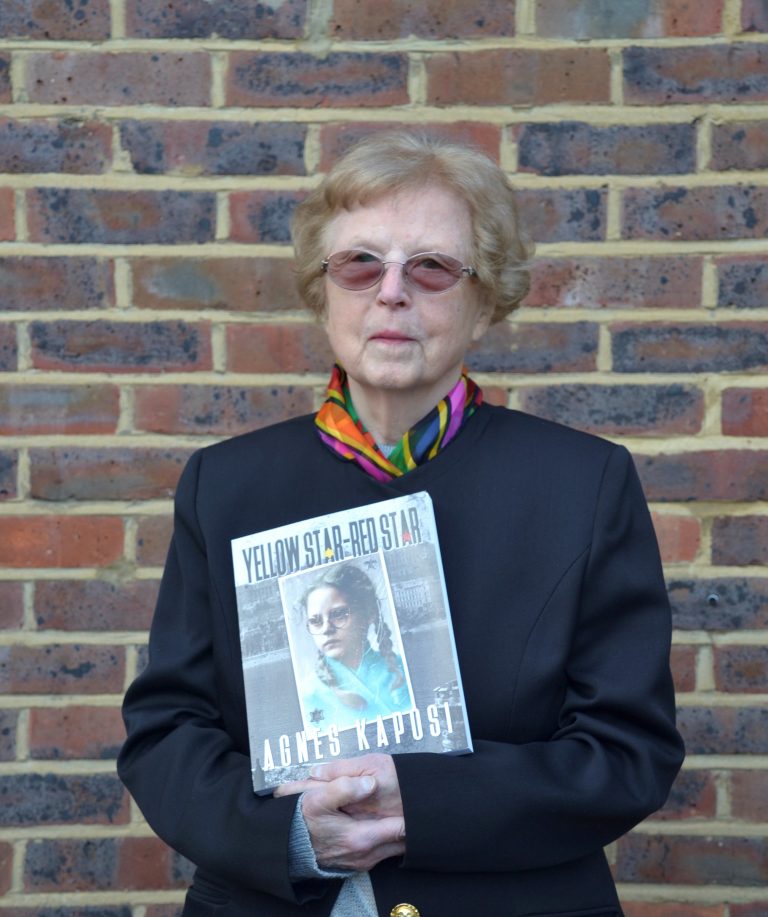
Dr. Agnes Kaposi was born in Hungary in 1932, a year before Hitler came to power. She started school at the outbreak of World War II. Many of her family and friends were murdered in the Holocaust, together with half a million other Hungarian Jews, but a series of miracles and coincidences allowed her to survive. She worked at age 11 as a child labourer in the agricultural and armament camps of Austria and was liberated by a rampaging Soviet Army. She struggled through post-war hardship to re-enter Hungarian society, only to be caught up for a decade in the vice of Stalinism. In 1956, the Hungarian revolution offered the opportunity to escape. Entering Britain as a graduate engineer, she started a family and built a career as a researcher, educator and consultant. She was the third woman to become a Fellow of the Royal Academy of Engineering. She is the author of a recent memoir co-written with historian Laszlo Csosz of University of Budapest, Yellow Star-Red Star (i2i Publications, Manchester).